Cocoa Butter - The Magic Ingredient
In this class you'll learn everything, and maybe more, that you need to know about cocoa butter
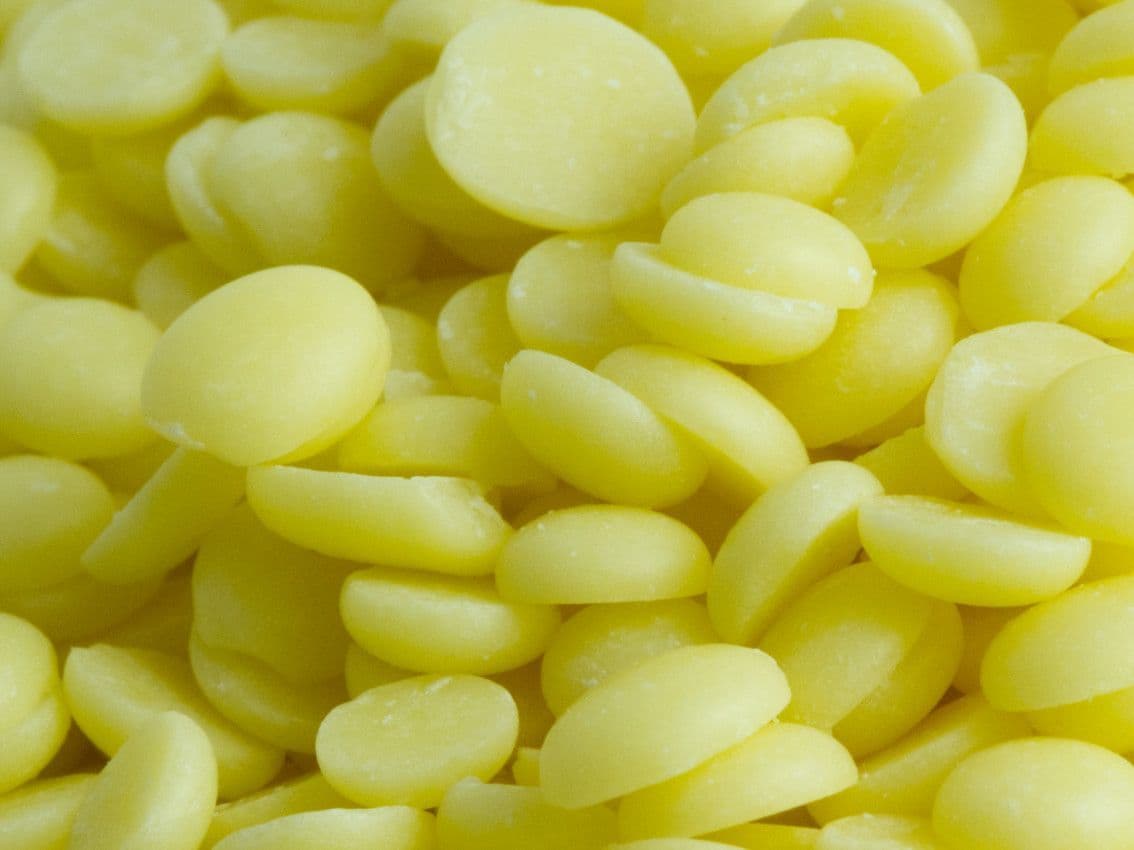
You might be asking yourself why the Chocolate School starts with a lesson on cocoa butter. But rest assured, I’ll explain why we’re beginning here and everything you’ll ever need to know about cocoa butter. Perhaps even more than you actually need to know.
Let’s start with the basics. Cocoa butter is the fat found in the cocoa bean, and naturally, also in the chocolate that’s made from it. The amount of cocoa butter in chocolate largely depends on how much extra cocoa butter is added during production. Reasons for adding cocoa butter include creating chocolate that’s easier to work with—read: has lower viscosity—or improving texture. The higher the cocoa butter content in chocolate, the more brilliant a shine you can achieve.
This is part of what makes cocoa butter magical: it’s solid at room temperature, contributing to the firmness of chocolate and that satisfying snap when you break off a piece. But it melts beautifully at body temperature, giving chocolate that extraordinary mouthfeel when you eat it.
Beyond these properties, there’s another feature worth mentioning: the stunning shine that properly tempered chocolate can achieve. A common question is how to make chocolate shine, and the answer lies in ensuring the chocolate is correctly tempered. Properly tempered chocolate has precisely the type of crystals in the cocoa butter we’re aiming for. And this leads us to the structure of fats and crystals—hold onto your hats, it’s about to get nerdy!
The Composition of Cocoa Butter
Cocoa butter has a relatively simple composition of fatty acids, predominantly palmitic acid (saturated fat), stearic acid (saturated fat), and oleic acid (monounsaturated fat).
Three Types of Fat
Cocoa butter is mainly made up of three kinds of fat
When it comes to the fats in cocoa butter, it’s also fairly straightforward. There are three main triglycerides (compare this to milk fat, which contains over 400 different triglycerides):
- POP – Contains two palmitic acids (saturated fats) and one oleic acid (monounsaturated fat). This is the most common triglyceride in cocoa butter.
- POSt – Contains one palmitic acid, one oleic acid, and one stearic acid (saturated fat). This triglyceride affects cocoa butter’s texture and melting point.
- StOSt – Contains two stearic acids and one oleic acid. This triglyceride has a higher melting point than the other two, making cocoa butter hard at room temperature. The higher the StOSt content, the firmer the cocoa butter.
Interestingly, research shows that cocoa butter becomes harder the closer to the equator the cocoa is grown. This suggests that these cocoa beans contain higher levels of StOSt. Microclimates and the variety of cocoa beans also play a role.
A triglyceride is a type of fat, though not all fats are triglycerides. Think of it like sugar being a type of carbohydrate—there are other types of carbohydrates too. Triglycerides are the most common type of fat found in both food and our bodies.
Did you know that cocoa butter is also used in cosmetics? Lipstick is a great example!
Polymorphism
Here’s another “big” word for you: polymorphism. Polymorphism simply means “many forms.” Poly means several, and morphism refers to form or structure, derived from the Greek words polys and morphe.
Cocoa butter is polymorphic. You’ve probably heard about the different crystals in cocoa butter—that’s what polymorphism is all about here. Cocoa butter can form several crystalline structures, each with a distinct melting point.
These crystals are often referred to by numbers. Let’s take a look at them and their melting points:
| Name | Melting point |
|---|---|
| I | 17.3°C |
| II | 23.3°C |
| III | 25.5°C |
| IV | 27.5°C |
| V | 33.8°C |
| VI | 36.3°C |
This classification is based on research from 1966. However, studies from 1999 suggest there may be only five forms, so the jury’s still out.
Type V crystals are what you want when tempering chocolate—or more accurately, during pre-crystallization. These crystals give chocolate its hardness, that satisfying snap, and its mirror-like shine. Type VI crystals can’t be formed in your kitchen; they arise from a polymorphic transformation, where type V crystals convert to type VI over time.
Crystals of types I, II, III, and IV are undesirable. The reason cocoa butter can form different crystals lies in how the fat molecules arrange themselves into various structures.
Ever found old chocolate in your pantry that looks almost white? This often happens when the crystals in the chocolate transition to type VI, affecting its appearance.
Pre-crystallization, Crystallization, and Tempering
We’re not talking about chocolate itself here, but about cocoa butter. It’s the cocoa butter in chocolate that we pre-crystallize (temper). The sugar, other fats, and dry cocoa solids in chocolate aren’t the reason we do this. These elements influence the cocoa butter (especially other fats), but more on that another time.
Whether you use silk, Mycryo, or the seeding method, the underlying technique is the same: you’re introducing type V crystals rather than creating them from scratch, as is done with the so-called “tabling” method. The goal is the same, even if the approaches differ.
Pre-Crystallization
It's called pre-crystallization because working the chocolate (and the cocoa butter) is what ensures the right crystals form.
How does it all work? What’s happening? Let’s break it down.
It all begins with what’s called nucleation. This occurs when the different fats in cocoa butter are supercooled—cooled below their maximum melting point.
In this context, nucleation means creating type V crystals in cocoa butter by cooling it while stirring, which serves as seeds for the rest of the cocoa butter. This is where crystallization starts: pre-crystallization.
There’s one problem, though—type IV crystals will also form, which is why the cocoa butter needs to be slightly warmed afterward to melt these away, leaving only type V crystals in the cocoa butter.
If you’ve been paying attention, you might have realized this process only applies to the tabling method. If not, now you know.
When you use silk, Mycryo, or the seeding method, you skip the nucleation step entirely!
Seeds: Tiny Clusters
Whether you’ve tabulated or used one of the other methods, you’re now at this stage. What happens next is the crystallization of the cocoa butter. The type V crystals that were created (or introduced) will now act as “seeds” for the rest of the crystallization. Physically, the fat molecules in the cocoa butter that haven’t yet formed crystals will align themselves with the existing type V crystals. This is the process of crystallization.
Once complete, a stable crystalline network forms within the cocoa butter. Have you ever noticed that chocolate poured onto parchment paper or your counter crystallizes from the edges inward? That’s because the temperature drops faster at the edges of the mass. The crystals grow layer by layer, and if the temperature drops quickly, multiple layers can form simultaneously.
Now you know plenty about cocoa butter. Are you ready to take the next step? If you want to dive even deeper into how, for instance, milk fats influence cocoa butter, stay tuned for part two on cocoa butter.